The need to find classroom examples beyond textbook diagrams has long been sought by computer science teachers. Real-world systems provide students with concurrency, compliance, and operational trade-offs that are not possible to model simplified. Gambling business, with its infrastructure-intensive requirements and high turnover in technical personnel, has become an unsung educator of cloud and grid concepts in contemporary IT education.
Educators studying deployment in India (IN) often reference Pinkybet casino, where the online casino registration, Pinky Bet sign in, login, and official website flows demonstrate how regional authentication scales under real traffic loads.
Examples such as these provide students with a point of reference to otherwise abstract concepts. The handling of sessions, validation of tokens, geo-distributed databases, and simultaneous user management are all apparent in platforms that are under continuous load.
Why Casino Platforms Became a Case Study Staple in CS Classrooms
The engineering constraints are what are interesting to educators about the sector, rather than the product. The systems in this space have to support thousands of transactions at the same time, have sub-second response times, and meet jurisdiction-specific regulations.
The classical examples of textbooks, such as simple e-commerce checkouts, simple CRUD applications, seldom generate such conditions in a classroom lab. Gambling-based infrastructure discussions, in contrast, discuss authentication under load, real-time event processing, pipelines to detect fraud, and data stores geographically partitioned.
That combination is directly correlated with the topics in the current cloud computing syllabi. Teachers do not need to use idealized diagrams but can reference real-world production systems that the students can use as a basis of how theory is applied to deployment choices.
From Monolith to Distributed: A Teaching Progression
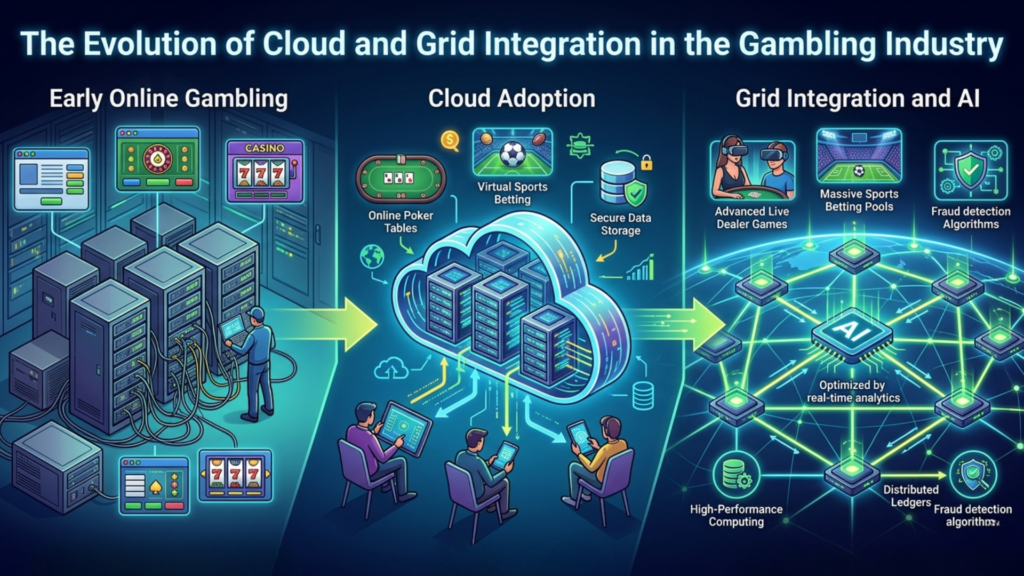
The history of architecture of the industry is a curriculum outline. First generation platforms were single-server monoliths, which were effective when dealing with small user bases but failed with regional growth. The very fact of that collapse is a lesson in itself – it shows that there are limits to vertical scaling.
In the next ten years, operators went through a sequence that is consistent with the organization of distributed systems courses:
- Monolithic servers with direct database coupling
- Three-tier architectures separating presentation, logic, and data layers
- Service-oriented architectures with defined message contracts
- Containerized microservices orchestrated across clusters
- Event-driven systems built on streaming platforms
Every step came with tangible lessons of failure modes, complexity of deployment and cost of operation. Students who follow this arc are able to not only see what distributed systems look like today, but also why the field got there. The fact that historical framing is hard to recreate with fictional examples is something that instructors struggle with.
Cloud Integration as a Living Case Study

The most researched stage of this development was migration to cloud-native infrastructure. Sites that used to run on dedicated hardware were migrated to elastic compute, managed databases, and content delivery networks – and publicly, via engineering blogs, conference talks, and open-source contributions.
EDUCAUSE reports that case-based learning based on real-world infrastructure scenarios is a much more effective way of teaching complex systems concepts to undergraduate IT students, and retaining them. The cloud migration of the gambling industry offers just such content.
It is taught by instructors to teach auto-scaling policies, blue-green deployments, and multi-region failover. Since traffic on these platforms is predictable around large sporting events, students will be able to study published reports of incidents and capacity plans that reflect the workload modeling taught in higher coursework.
Grid Computing and Load Distribution
In conjunction with cloud migration, the industry implemented grid-like computing to manage peaks that would exceed normal cloud allocations. Concurrent sessions can increase by a factor of order of magnitude in minutes when a big match or tournament is starting.
Grid architectures spread that load to multiple compute pools, which may be in different data centers. These scenarios are used by instructors to teach parallel and distributed computing using job scheduling, resource arbitration, and fault tolerance.
The measurable outcomes are a source of pedagogical value. Technical post-mortems record latency, throughput, and failure rates during peak events, providing students with real numbers to reason about, rather than textbook estimates.
Regional Deployment as a Classroom Exercise
The deployment by region is one of the more educative elements of the sector. Laws on data residency, latency requirements and local compliance models compel operators to scale infrastructure on a market-by-market basis instead of operating a single global stack.
A second instructive example appears in New Zealand, where Degencity casino and its Degen City online casino registration, login to Degencity, sign in, and official website workflows show how infrastructure adapts to local compliance and latency requirements.
Students studying this type of deployment get to know how to consider a number of parallel design factors:
- Data residency and cross-border transfer restrictions
- Regional latency budgets and CDN placement
- Jurisdiction-specific authentication and identity verification
- Currency, language, and regulatory reporting differences
- Peak traffic windows tied to local time zones and events
All the factors are design constraints, not theoretical footnotes.
What Educators and Curriculum Designers Take Away
To instructors developing or updating a course in cloud computing, the lessons of researching this industry are likely to fall into several themes:
- Real production constraints produce better engineers than synthetic lab exercises.
- Observable architectural evolution is more memorable than end-state snapshots.
- Compliance and regional variation are easier to teach through concrete examples than through policy summaries.
- Failure case studies — outages, post-mortems, capacity misestimations — embed lessons more durably than success stories.
- Mapping industry progressions onto course modules keeps curriculum aligned with current practice.
Curriculum designers are paying more and more attention to the fact that at least one sector-based case study in every course module enhances student engagement, especially in those areas where abstract theory has long dominated lectures.
Closing Notes for the Classroom
The cloud and grid development in the gambling industry is in essence a readable technical history. To instructors who attempt to introduce distributed systems theory to the contact with production reality, it provides a series of architectural choices that can be followed and challenged in coursework. The classes that are based on such examples are likely to result in students who already think in terms of scale, region, and operational cost when they come to the field.